Horizontal boring machines by DMG MORI Precision Boring
DMG MORI Precision Boring Co, Ltd (formerly KURAKI Co, Ltd), has a history: Since 2017, the two companies have been working together to offer the US market not only innovative CNC machine tools but also highly precise and reliable horizontal boring mills. In addition to integrated manufacturing solutions, this also includes strong on-site services. The company is based in Nagaoka-city, Niigata, Japan. Customers from the tool and mold making, energy technology and aerospace industries value the technology of DMG MORI Precision Boring Co., Ltd. But what is the story behind the company? And what makes the horizontal boring and milling machines (HBM) so special? Mr. Kenichi Nakamura (General Manager, Machining Center Development Department) has the answers.
Please tell us something about the history of KURAKI.
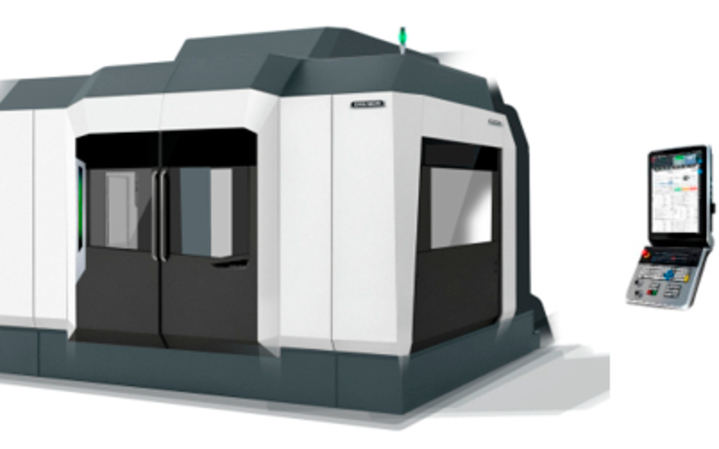
Kuraki Co, Ltd, was founded in 1938 in Nagaoka, Niigata, Japan, by Kurabo Industries Ltd. In the late 1970s, we began exporting from Japan to the U.S. and established Kuraki America Corp. in 1981. We have been dedicated to manufacturing horizontal boring and milling machines (HBM) from the beginning. To date, we have delivered about 7,000 HBMs worldwide. We currently have 3 overseas offices in the USA, China and Taiwan.
Kuraki America Corp. was founded in 1981 as a subsidiary of Kuraki Co, Ltd. in the USA. It is responsible for the import, sales and service of our products in the USA, Canada and Mexico. Since 2024, we have been operating under the name DMG MORI Precision Boring Co., Ltd.
For which industries are DMG MORI Precision Boring technologies of interest? Which components are manufactured?
Our customers come from the energy sector, construction, mining, transportation, aerospace and mold making, to name but a few. With the US company Advance Mfg. Co. Ltd. we also have a company that specializes in precision machining for the army. Our machines can also be found in shipbuilding for the construction of housing parts (Sasebo Heavy Industries Co., Ltd., Japan) or at companies that are active in the railroad sector. The Austrian company Plasser & Theurer, for example, uses our systems to produce various frames and parts for train carriages.
What are the main technical differences between a conventional drilling machine and a horizontal boring machine?

In a typical HBM, the movement of the W-axis (drill spindle in and out) is only used for positioning. It is not possible to machine while the W-axis is moving. Our DMG MORI Precision Boring machine can also do this while the W-axis is moving. For example, continuous drilling with small diameters and tapping with small diameters can reduce energy consumption by using the W-axis. In addition, our B-axis rotary tables are equipped with a unique drive mechanism that enables smooth and extremely accurate indexing, even with heavy workpieces. Our unique and powerful clamping mechanism enables large machining with large drill diameters.
What are the main challenges with horizontal boring mills?
In future, we will have to respond to higher speeds, staff shortages and increasing complexity. Horizontal machining centers are advantageous when high spindle speeds and high feed rates are required. We want to continue to work on increasing spindle and feed speeds in the future.
One of the advantages of the DMG MORI Precision Boring horizontal boring and milling machine is its versatility. However, automation is not easy, as much of the work is done manually by the operators. Here we see potential for the future in the standardization of the pallet changer or better operability or support by processing software.
Which applications require horizontal boring mills?
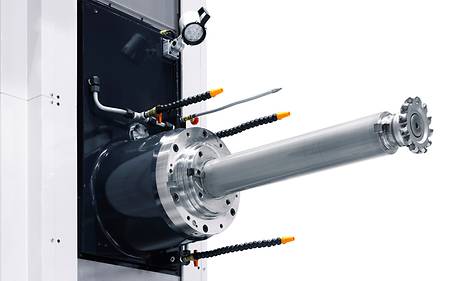
The majority of workpieces to be machined are in the 700 x 700 x 700 mm range. HBMs from DMG MORI Precision Boring Co., Ltd. are suitable for machining large and medium-sized parts with larger machining areas due to the W-axis drilling spindle and the B-axis rotary table. The machines have a stroke that exceeds the table size, making it possible to machine long or tall workpieces. In addition, the high rigidity of the spindle head enables the use of large special tools with torque supports, 3-point supports, etc.
What makes them better than universal machining centers? (Precision, speed, etc.?)
The basic configuration of our HBM is the same as that of a horizontal machining center, including advantages such as reduced set-up times and shorter work processes. On the other hand, our HBMs have a significantly stiffer machine structure. This enables the use of spindles with a multiple torque and therefore a significantly higher cutting performance compared to a normal machining center.
We also offer mechanical control of U-axes through the spindle, which offers additional advantages, particularly in the energy sector or in aviation.
What are the advantages of DMG MORI Precision Boring Horizontal Boring Mills?
Our HBMs can be used for large machining areas, are versatile and easy to operate. This is ideal for customers who require rapid individual machining of medium to large parts.
In addition to DMG MORI Precision Boring, there are other manufacturers of horizontal boring machines. How do the machines of other market players differ from DMG MORI Precision Boring machines? Is there a unique technical feature?
We specialize in the construction of HBMs. Our portfolio includes everything from small to ultra-large machines and we also offer models that the competition does not have: Table types for long and multiple workpieces, combination table types consisting of table and rotary table or face spindle and deep drilling spindle. We also respond flexibly to customer requirements and make changes to the stroke of each axis and the table size, for example, on request.
It is well known that horizontal boring mills are mainly used for extreme machining requirements. Do you have an example?
For example, the machining of a large frame for construction machinery that is attached to an angle plate. Or the individual machining of large holes such as those used in oil system distributors. Large drills with a large diameter are required here. Another example: Hubs and nacelles for wind power generators or extremely large holes on crankshafts for marine engines or the rough machining of injection molds.
You mention high positioning accuracy on your website. Can you explain how these systems were technically implemented to work so precisely?
We use box slide ways for the X, Y and Z axes of our products. The fixed side is hardened and polished. The moving side is coated with Turcite and hand-scraped to ensure rigidity and vibration damping. Large dimensioned ball screws with a low lead angle are used to drive the X, Y and Z axes and increase feed rigidity and force. The W-axis is guided by the precision-machined inner diameter of the milling spindle and an additional guide at the rear of the spindle housing. The W-axis is driven by a ball screw with a small lead angle and large diameter.
You also offer your customers automation options. What are these?
2APC shuttle-type pallet changer for very heavy workpieces is an option. The combination of various automatic measuring functions (workpiece probe, tool probe) makes it easier to automate the processing of large-format workpieces.
DMG MORI Precision Boring horizontal boring and milling machines are equipped with monitoring and diagnostic systems. What are these systems? How do customers benefit from these systems in detail?

The following 3 functions can be provided as options:
Spindle load monitoring system: spindle load monitoring, override control functions, spindle load monitoring of each tool
Energy saving function: to optimize machine power consumption in standby mode
Spindle thermal distortion compensation system: to compensate for the thermal expansion of the spindle due to high-speed rotation.
Which control systems are integrated into your machines?
Currently, only FANUC Series 31i controllers are used in our production machines.